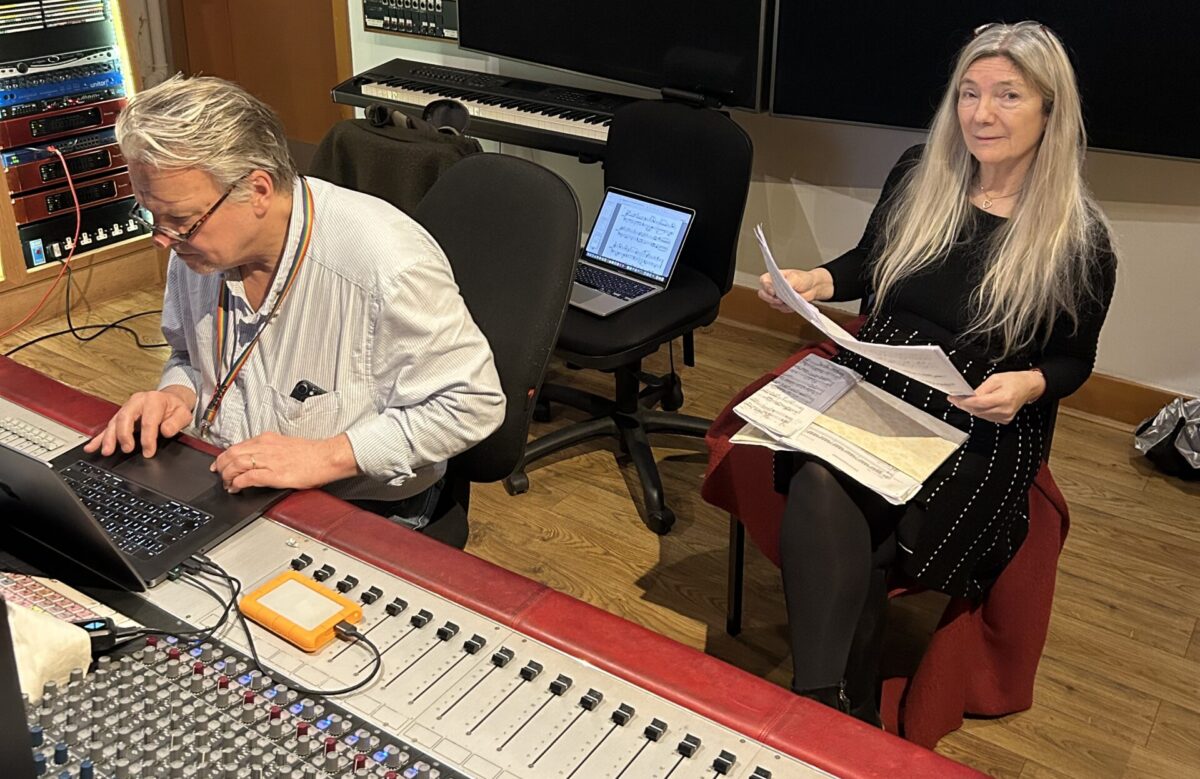
Divertissements (again) in Amsterdam

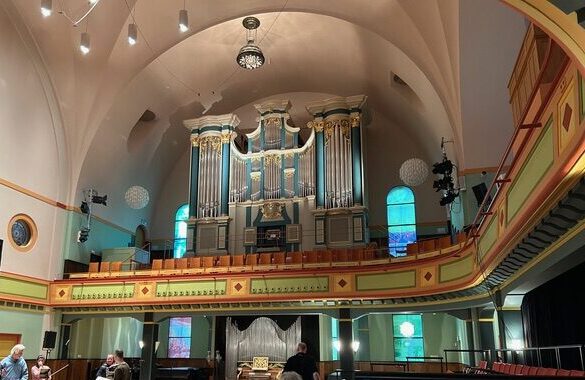
November 2025: yet another version of Divertissements received its world premiere at the Orgelpark, Amsterdam, courtesy of Prix Annelie de Man 2025 and the ensemble Black Pencil. The piece’s champion, harpsichordist Jane Chapman, teamed up with percussionist and composer Enric Montfort augmented with a ‘tape’ part utilising vintage synthesisers from the Townshend Studio at the University of West London.

November 2025: yet another version of Divertissements received its world premiere at the Orgelpark, Amsterdam, courtesy of Prix Annelie de Man 2025 and the ensemble Black Pencil. The piece’s champion, harpsichordist Jane Chapman, teamed up with percussionist and composer Enric Montfort augmented with a ‘tape’ part utilising vintage synthesisers from the Townshend Studio at the University of West London.

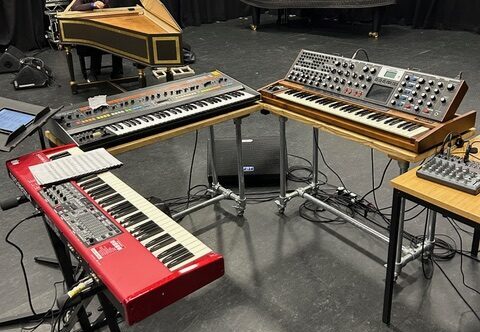
This version (the number of which I have lost count of at the time of writing!) is essentially a more ‘formalised’ approach to the kind of improvisation with that characterised the improvised version Jane and I performed at the LCM Composition Festival in June. This time there is a score but it is largely schematic, with brief verbal instructions/guides for the percussionist and fragmented stimuli for the harpsichordist to improvise with. The tape part uses the trusty Jupiter 8 and Moog Voyager alongside the Sequential Circuits Prophet 10 and the Yamaha DX1 – a more expensive cousin of the widely-used DX7. I made recordings of improvisations on these instruments and then either used these directly or after various kinds of digital manipulation in Logic Pro 11.

Jane’s and Enric’s performance was very good indeed. Jane and I had minimal communication with Enric prior to the performance but he had absorbed the score and the soundworld of the piece astutely and he and Jane improvised with great awareness of each other and the ‘tape’ part, sometimes dialoguing, sometimes going their own way. The result produced an instance of Divertissements that I could never have notated but, more importantly, had an energy characterised by the tension that a spontaneously created performance can bring.

Divertissements at LCM Composition Festival

June 2025: Jane Chapmen, Simon Zagorski-Thomas and I played at the LCM Composition Festival at the University of West London with the world premiere of two new versions of Divertissements and spin-off electronic studies (with video) by Simon.

June 2025: Jane Chapman, Simon Zagorski-Thomas and I played at the LCM Composition Festival at the University of West London with the world premiere of two new versions of Divertissements and spin-off electronic studies (with video) by Simon.

These versions have arrived mid-way through a project to create a studio version of Divertissements, i.e. one that uses the studio as an instrument with which to sculpt a unique iteration of the piece that is not constrained by the practicalities of live performance. What this means is an enhanced role for Simon as a producer, akin to how this role might play out on a pop recording. Simon is an equal creative partner alongside Jane and I, bringing his research into ‘hyper-production‘ to bear on our piece. A crucial component of the studio version are the vintage synthesisers of the Townshend Studio collection at UWL, in particular the Roland Jupiter 8. The synth material comes from a much older piece of mine, Blag, written for Icebreaker during 1992-4.

The versions performed in June took the original harpsichord and synthesiser materials as starting points with live FX performed by Simon. We first played using the synthesiser parts on ‘tape’ with me adding an additional live layer on the Jupiter, Moog Voyager and a Nord Electro 4. This version inevitably ended up being sonically rather ‘crowded’; an experiment that did not prove entirely successful. On the other hand, our second performance was an improvised account of the score; Jane played through all the materials, improvising with them (as opposed to ‘on’ them), whilst I responded with a range of freely improvised synthesiser materials conjured from my intuitive responses to different patch settings. This version was far more successful with space for genuine dialogue between Jane and I whilst Simon had room to insert FX, enhancing and enlivening the overall sound picture.

A link to this second improvised version can be found on Jane Chapman’s YouTube channel.

Trio Agile at Late Music (again)

May 2025: as will have been apparent over the last few news items, Late Music York have been a great supporter of my work in 2025 and many previous years as well as the instigators of several important projects. This opportunity comes courtesy of a joint project between Late Music, students from the Northern School of Contemporary Dance and Music on the Edge (in the shape of Trio Agile – Susie Hodder-Williams, Chris Caldwell and Richard Horne).

May 2025: as will have been apparent over the last few news items, Late Music York have been a great supporter of my work in 2025 and many previous years as well as the instigators of several important projects. This opportunity comes courtesy of a joint project between Late Music, students from the Northern School of Contemporary Dance and Music on the Edge (in the shape of Trio Agile – Susie Hodder-Williams, Chris Caldwell and Richard Horne).

When Chris Caldwell asked me to contribute to Late Music/Music on the Edge’s ‘Agile’ project with the Northern School of Contemporary Dance it didn’t take me very long at all to decide on revisiting Black Maria, the ballet score I composed in 2007 for a production at Sadlers Wells choreographed by Susie Crow with video projection by Zara Waldeback. Black Maria (‘black’ as in ‘witch’/’magic’) is a novel for children by Diana Wynne Jones to whom I happen to be related (she was my mum’s elder sister). Diana’s novel is set in the seaside town of Cranbury that is ruled over by Aunt Maria, a not particularly benign witch, whose coven is run by the women of the town (the Mrs Urs). Into this strange world comes Mig and her family (Mum and brother Chris) who immediately rub up against Aunt Maria’s version of reality; a complex and chaotic series of events ensue involving mind control, telepathy, being buried alive, time travel, shape-shifting, green boxes, wolves, orphans and love stories.

Whittling Diana’s plot down to an 80 minute ballet was hard enough but for the Agile project I set myself the challenge of ‘miniaturising’ the 40 minutes of Act 1 to fit the 5 minutes duration of the commission! I have managed to preserve the main events of the narrative through a series of ten 30 second sections but, beyond this, I have ‘fast forwarded’ through material, truncated phrasing, avoided most repetition and eschewed all transitions. The result is a kind of mad-cap intensification of the original ballet in which ideas rattle by in a medley that, I hope, captures something of the colour and eclecticism of the original score.

If all goes well with the 3rd May premiere then I plan to take the same approach to Act 2. Completing the piece, entitled Aunt Maria’s Dancing Master, came down to the wire but I am hoping the dancers on the project will feel able to improvise to the score and, to this end, I have dredged up some publicity photos and literature from the original production to provide inspiration. It was been great fun revisiting a piece written almost 20 years ago that remains one of my proudest achievements because of the quality of the music and the success of the collaboration. I am sure the Agile project will do Aunt Maria proud.

Variation Tapestry I – Premiere

April 2025: pianist Jakob Fichert gave the premiere of Variation Tapestry I – a composed programme of variation works – at Late Music York. This piece is another collaborative project although with a shorter backstory than some dating, as it does, to 2023.

April 2025: pianist Jakob Fichert gave the premiere of Variation Tapestry I – a composed programme of variation works – at Late Music York. This piece is another collaborative project although with a shorter backstory than some dating only as far back as 2023!

The roman numeral attached to the title is important here because it denotes Variation Tapestry as a piece expressly designed to exist in different versions, in fact it could almost be said to constitute a procedure for making a piece rather than a musical work in its own right. For this first outing Jakob and I decided to present the tapestry as a series of panels in which a pair of variation-type pieces was interwoven. The four panels comprised:

  1. Copland Variations – Armstrong Dance Maze: Variations
  2. Von Albrecht Piano Sonata in C Minor 2: Adagio – Stevenson Passacaglia on DSCH: Tempo di valse, Lento lamentoso
  3. Schumann Études in the form of free variations on a theme of Beethoven – Beethoven trans. Liszt Symphony No. 7 in A Major 2: Allegretto
  4. Bartók Improvisations on Hungarian Peasant Songs: 3 & 8 – Leighton Nine Variations: 2 & 4

Within each panel the pieces are woven together, sometimes alternating sections, sometimes embedded within each other. The process of weaving involved finding points to segue from one piece to another, guided by a strategy of non-intervention under which changes to the originals were avoided unless absolutely necessary. The result is a composition process that is about working with large pre-existing blocks of material, composing at a much lower resolution, hence the ‘composed programme’.

Although Jakob left the weaving to me he was instrumental in suggesting much of the repertoire, in particular Schumann’s wonderful études/variations on Beethoven’s 7th symphony (the Allegretto of which is itself a chaconne-type variation movement). Jakob also introduced me to Busoni’s 3rd elegy with its chorale prelude variation form. In fact when we began this project back in March 2023 we made a huge list of potential pieces including variations by Henze and Reger (both recommended by Jakob), Bartók dirges, pieces by John Adams and Steve Crowther as well as two sets of variations on Walsingham by Byrd and Bull. The joy of our project is that, with sufficient thought, trial and error, any work can be woven together with any other making Variation Tapestry a wonderfully open-ended antidote to the delimited ‘works’ that still tend to dominate most recitals.

Mine and Jakob’s ultimate aim is a continuous programme of interwoven music so the next stage of our collaboration is to break down the four panels by locating multiple points of connection and by reintroducing music we had to leave out for York due to time restrictions (the Byrd and Bull Walsinghams, the Busoni Elegy). Variation Tapestry started as a way of collaborating with Jakob to provide a programme context for my own Dance Maze: Variations but it has led some way beyond this somewhat limited goal and now looks towards a more fluid and collaborative approach to the classical piano recital.

Roger Marsh at 75

March 2025: up to York Late Music to celebrate Roger Marsh’s 75th birthday with Trifarious including pianist Alex Wilson.

March 2025: up to York Late Music to celebrate Roger Marsh‘s 75th birthday with Trifarious including pianist Alex Wilson.

Roger was my supervisor for the DPhil I undertook at the University of York in the early 90s but he arrived at York around 1988 when I was a second year undergraduate and, under his tuition, I took modules (or ‘projects’ as they were known at York then) in composition and music theatre (the latter based around Roger’s large-scale Old Testament drama The Big Bang). Roger was an excellent lecturer – entertaining, committed, someone who wore his knowledge lightly and who, although he laid his aesthetic cards on the table for his students, allowed us to respond to the various compositional stimuli he placed before us in our own ways. As a doctoral supervisor Roger was challenging and inspiring. The process of supervision was very different in the early 90s from the regular, hands-on, closely monitored process it is today (at least in the UK); I don’t remember very regular sessions with Roger but for each piece I worked on with him he made at least one comment that really made me think – sometimes it annoyed me as well (as when my piece for Icebreaker, Blag, was deemed to have ‘not many colours’) but was generally proved to be correct once I’d calmed down!

Trifarious performed two pieces by Roger: Easy Steps for piano (1987) and Ferry Music for clarinet, cello (arranged by me for viola) and piano (1988). Alex Wilson delivered a blistering performance of Easy Steps and Ferry Music‘s contrasting panels of colour and action came across vividly. Context was provided by Berio’s set of encores for piano, Takemitsu’s The Bird Came Down the Walk for viola and piano and then two pieces by Roger’s pupils – myself (represented by The Chief Inspector of Holes) and David Power (Six De Chirico Miniatures for solo piano). The Chief Inspector had not been heard for some time prior to this concert, in fact I worked out (in preparing some text for Roger) that it has a performance rate of one every ten years! This time I took the narrated part myself and enjoyed bringing the piece back to life; I just about managed to project over the more raucous passages of trio writing.

I composed The Chief Inspector in 1994 just after finishing with Roger and after returning from the 1993 Contemporary Performance and Composition course at the Britten Pears School, Snape – a rather different experience and a difficult one at that; the piece has Marshy elements mixed into music of a neoclassical strain, an approach that served me for quite some time and that I occasionally resurrect although it can lead me down rather dry, somewhat academic avenues if I don’t introduce some indiscipline now and again.

Retroperspective at Longparish

February 2025: my long-running collaboration with Trifarious finally saw the light of day before a paying audience at St Nicholas’ Church, Longparish in Hampshire’s Test Valley.

February 2025: my long-running collaboration with Trifarious finally saw the light of day before a paying audience at St Nicholas’ Church, Longparish in Hampshire’s Test Valley.

Retroperspective is a project that Trifarious and I have been developing since 2020! The aim is to present arrangements of (broadly defined) ‘classical’ music by composers both familiar (Bach, Beethoven) and unfamiliar (Louis Couperin, Joseph Bologne Chevalier de Saint-Georges, Lillian Elkington, Chiquinha Gonzaga) in a way that suits a broad audience including seasoned concert-goers and those new to, or wary of, classical recitals. As Retroperspective has evolved it has taken on a more multi-media aspect and now incorporates lighting, video, found audio and electronics all controlled with an Ableton push MIDI controller.

The driver of the technology has been Trifarious’ saxophonist/clarinettist, Tim Redpath. I’ve been constantly amazed at how Tim has been able to match the ambition of his ideas as they emerged: green screen – no problem, drone footage – done, multitrack recording synced to the live parts via click track – easy! This hasn’t meant a completely smooth process nor, indeed, a glitch free first performance but the technology we have used has allowed us to expand Trifarious’ resources beyond their wind/string duo line-up and to place the arrangements in vivid audiovisual contexts.

If the audience reaction in Longparish was anything to go by, we are on the right track. I am used to polite applause and one or two warm words after first performances but Tim, Rachel and I all sensed a genuine enthusiasm for what we had presented, perhaps helped by the standing ovation! Despite this success there is a process of refinement to undertake: we need to work on making the transitions between pieces completely seamless with no break in either sound nor image and we need to give the Gonzaga arrangement a nip and tuck (probably adding in a reworking of Dvorak’s American quartet); the arrangement of Beethoven’s symphony no. 5 first movement could also be more radical with more attention to sound design, integration of Beethoven’s many sketches and/or Schenker’s famous analytical graph of the piece. Finally there is the small matter of interesting a diverse selection of venues up and down the country in our project, then applying for funding to allow us to tour! More news as and when I have it.

A Book of Song – First Outing

Late January – February 2025: A Book of Song, a collaboration with composer/pianist Nathan Williamson and three singers, received its first try-out performance at Sophie’s Barn, Chacombe.

Late January – February 2025: A Book of Song, a collaboration with composer/pianist Nathan Williamson and three singers, received its first try-out performance at Sophie’s Barn, Chacombe.

A Book of Song is a reimagining of the classical song recital for the 21st century. This entails two things: broadening recital repertoire to encompass vernacular musics alongside art song, and inviting the singers to bring to the process songs that they want to sing irrespective of whether they are regarded as ‘right’ for their voice types or conforming to promoters’ and audiences’ expectations for song recital repertoire. The result was a recital that ranged through Schubert, Fauré and Handel, contemporary music by myself and Hannah Conway, French pop (Ceux qui revant by Pomme) and Sudanese folk song.

But Nathan and I aimed to go much further than simply questioning repertoire; we wanted to create a seamless, composed, programme in which songs were re-arranged, re-composed, segued, superimposed and generally treated as compositional material rather than revered works. We also wanted to work with the singers from the ground up, being led by them and their particular skills, using improvisation and taking an approach closer to theatrical devising than the conventional, paper-based, composition we both normally practice.

A Book of Song would be nothing without our singers: soprano Clara Barbier, countertenor Magid El-Bushra and baritone Rob Gildon have embraced the concept of a recital-as-composition and a more improvisatory way of working with gusto. During the two days of development we had in Sophie’s Barn prior to our performance on the evening of the third day we ran the gamut of collaboration – excitement, boredom, frustration, moments of sudden illumination, long periods of trial and error, capped off with the adrenaline rush of performance. For me the experience was immensely inspiring; it is a long time since I have been in such an intense and communal creative incubator and it took me a while to come down from the high of being one part of a successful artistic endeavour.

As I write we are awaiting the outcome of an application for a Britten Pears Arts residency at Snape Maltings. If successful we aim to use this to develop a longer programme approaching an hour in length and to refine our improvisatory approach, in particular to allow for greater fluidity and risk-taking in performance.

Partita Weaving

October 2024: to Trinity Laban Conservatoire for preliminary work with Head of Keyboard Ji Liu on my recent Bach reworking.

October 2024: to Trinity Laban Conservatoire for preliminary work with Head of Keyboard Ji Liu on my recent Bach reworking.

Partita Weaving uses materials from the first five Bach keyboard Partitas: the Prelude and Allemande from No. 1 in Bb; the Sinfonia from No. 2 in C minor; the Sarabande from No. 3 in A minor; the Overture from No. 4 in D; and the Praeambulum and Gigue from No. 5 in G. These materials are very extensive – significant portions of, or even whole, movements rather than brief quotations – and the result is a combination of medley and mashup with movements flowing into and out of each other (hence ‘weaving’) and frequent superimpositions. Musical ‘re-engineering’ aside, my aim in this piece has been to create only gentle disturbances in Bach’s originals; even when the right hand of one dance is superimposed on the left hand of another (as in the Prelude and Allemande from No. 1) my ear was guided by combinations that were almost plausible or plausible for just long enough before clearly departing from Bach’s harmonic world. I am not interested in modernist shock tactics nor postmodern irony and Partita Weaving joins a number of reworkings of mine – such as JPR, Distant Beauties and Tanzë – that stand as homages to their original creators.

It was exciting working with Ji on this music. He is the kind of pianist who regularly throws off Rachmaninov concertos or programmes of all Chopin’s Études and the range of colours he can bring to the keyboard through his formidable technique is vast. Even on a preliminary play/read-through the potential was there for a really special premiere. But Ji is a lot more than a virtuoso performer; I first encountered him as external examiner for his PhD on programming Schubert’s unfinished piano sonatas and Ji continues to investigate, though his pianism, ways of reinvigorating the contemporary piano recital. He is also a composer – for the piano, of course, but of orchestral music too. I look forward to working with Ji further before the new piece is unveiled.

More Sounds, More Personalities: British Postminimalism 1979-97

September 2024: myself, Ian Gardiner and Imogen Burman organised a conference at Goldsmiths dedicated to music by British composers who forged their musical language from US minimalism and English experimental music.

September 2024: myself, Ian Gardiner and Imogen Burman organised a conference at Goldsmiths dedicated to music by British composers who forged their musical language from US minimalism and English experimental music.

Organising a conference is a nerve-wracking experience; not only are there a myriad arrangements to take care of, beforehand and on the day, but there is always the nagging worry that no-one will be interested in the research niche being presented. This was particularly the case for Ian and I because the impetus for the conference had arisen from a very personal source; in July 2021 the composer Jeremy Peyton Jones passed away – a mutual friend and colleague, both of us were deeply shocked when we heard the news and, following a chance meeting whilst on external examining duties, we decided that something needed to be done to commemorate Jeremy’s life and work.

Ian had already organised a memorial concert for Jeremy in 2022, before he and I had become acquainted. Both of us were involved in what might be termed the alternative British contemporary music scene within which Jeremy was so important: Ian was a more central figure – a member of George W. Welch – whilst my activity centred around Icebreaker who arrived later, in 1989. We decided that this period warranted greater investigation, documentation and academic representation so a conference, one-day initially to ‘test the water’, was the way to go.

What transpired was a day that exceeded our expectations by some distance. The conference attracted a large audience many of whom (but not all – younger delegates and presenters featured too) were active in the period concerned and there was a definite ‘buzz’ and feeling of importance, of something valuable and relevant being shared.

A more or less complete set of conference materials are available at the above link but some of the themes I noted down for my summing up presentation give a flavour of the range of topics discussed: institutions; venues; process vs system; the impact of experimental music and John Cage; politics; multimedia/interdisciplinary/cross-arts practices; pulse-driven music and performance skills in undergraduate music education; instruments and technology; looking forward to further work may involve: oral history, mapping networks, archiving, lived experience and interleaving of artists’ lives into their work, preserving a legacy, focus on ensemble music-making.

Suffice to say that Ian and I are not going to leave it there – ideas are percolating and plans gradually forming for ways of taking this work forwards. Watch this space…!

Divertissements – Vestry Hall Recording

July 2024: time to lay down some harpsichord! Jane, Simon and I were at Vestry Hall in Ealing recording Divertissements, the notes written in the score as well as some we improvised together on the day.

July 2024: time to lay down some harpsichord! Jane, Simon and I were at Vestry Hall in Ealing recording Divertissements, the notes written in the score as well as some we improvised together on the day.

We recorded over three days with a view not only to getting the piece as written ‘in the can’ but gathering as much recorded material as we could to use creatively: takes in different tempi, ornamental passages, multiple harpsichord registrations. It is unclear at this stage quite how all this material will be used – perhaps a ‘straight’ version followed by some kind of extended mix, we’ll see. What is certain at the moment is that there is a long editing job ahead!