Divertissements – at the Townshend Studio

April 2024: yet another version of Divertissements is in the offing, this time for harpsichord and vintage synthesisers courtesy of the University of West London’s Townshend Studio.

April 2024: yet another version of Divertissements is in the offing, this time for harpsichord and vintage synthesisers courtesy of the University of West London’s Townshend Studio.

This iteration of the piece involves a three-way collaboration between myself, Jane Chapman and Simon Zagorski-Thomas, indeed Divertissements has, to some extent, now evolved into a trio – not only the synths but the recording studio itself is set to play a major role in shaping the sound of the music. The studio is, of course, very audible in most pop recordings but far less so in the production of classical music. Simon’s research, as articulated in his book The Musicology of Record Production and his AHRC project in Classical Music Hyper-Production, pays considerable attention to ways in which classical music might profitably interact with a creative approach to the recording studio.

At this stage, though, we are simply trying to get our ears round the vast resources of the Townshend synths. It looks likely we will only focus on a fraction of the collection but, even with this restriction, the possibilities are vast – and exciting!

Trifarious Testing in the Test Valley

April 2024: at St Nicholas Church, Longparish, with Tim Redpath and Rachel Calaminus (2/3 of Trifarious) to try out our arrangements of Beethoven, St George, Gonzaga and Elkington.

April 2024: at St Nicholas Church, Longparish, with Tim Redpath and Rachel Calaminus (2/3 of Trifarious) to try out our arrangements of Beethoven, St Georges, Gonzaga and Elkington.

One of the benefits of having six weeks ‘on the sick’ (see previous news item) was having time to complete the arrangements for this long-standing project. Chief amongst these were a condensation of the first movement of Beethoven’s fifth symphony (including finding ways of moving out of and back into the arrangement in order to use it as a ‘container’ for the other pieces on the programme) and a transcription (for clarinet, bass clarinet, violin and viola) of Lilian Elkington’s Out of the Mist. Elkington’s piece was composed to mark the repatriation of the Unknown Warrior in 1920; reminiscent, perhaps, of Delius, Out of the Mist is a sombre, deeply lyrical lament that, like all of Elkington’s music, disappeared from public view until a chance rediscovery (some fifty years after its premiere) in a Worthing bookshop. It has been a great pleasure to help bring Out of the Mist back to life.

St Nicholas Church proved a wonderful venue and we are looking forward to playing the programme here early in 2025.

New Year, New Hip

January 2024: the new year did not get off to the best of starts – a cycle ride one Sunday ended with me being taken to hospital in an ambulance after skidding on a roundabout and landing heavily on my right hip. I’ve come off my bike before and bounced (sort of) but not this time unfortunately. Still, there have been some compositional upsides!

January 2024: the new year did not get off to the best of starts – a cycle ride one Sunday ended with me being taken to hospital in an ambulance after skidding on a roundabout and landing heavily on my right hip. I’ve come off my bike before and bounced (sort of) but not this time unfortunately. Still, there have been some compositional upsides!

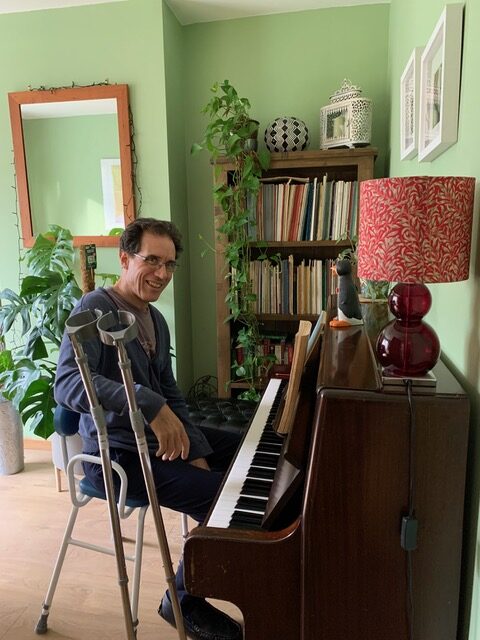
A hip replacement operation is pretty major surgery with the result that I find myself on six weeks sick leave. It has not been easy coming to terms with suddenly being an invalid – there is lots to get used to, lots of physio to fit in, lots of pain/discomfort to manage, lots of rest and recuperation. But I have also been suddenly handed just a little more composing time and this has helped me push certain projects forward and begin to disentangle the threads of overlapping, long term pieces of work. Chief amongst these has been the project with Trifarious that involves exploring the intersection between composing and arranging whilst constructing a seamless programme of familiar and less familiar classics capable of being easily toured around village venues. I’ve completed an arrangement of the first movement of Beethoven’s Symphony No. 5 for clarinet and violin that contains ‘openings’ into other works on the programme. I have also arranged Lilian Elkington’s orchestral memorial Out of the Mist, a piece depicting the arrival of the body of the ‘unknown soldier’ in 1920; here, live instruments are complemented with recorded tracks. The Elkington is an austere lament for the victims of war and, I hope, will form a kind of ‘still centre’ to the programme.

Damascene Redux Recordings Released

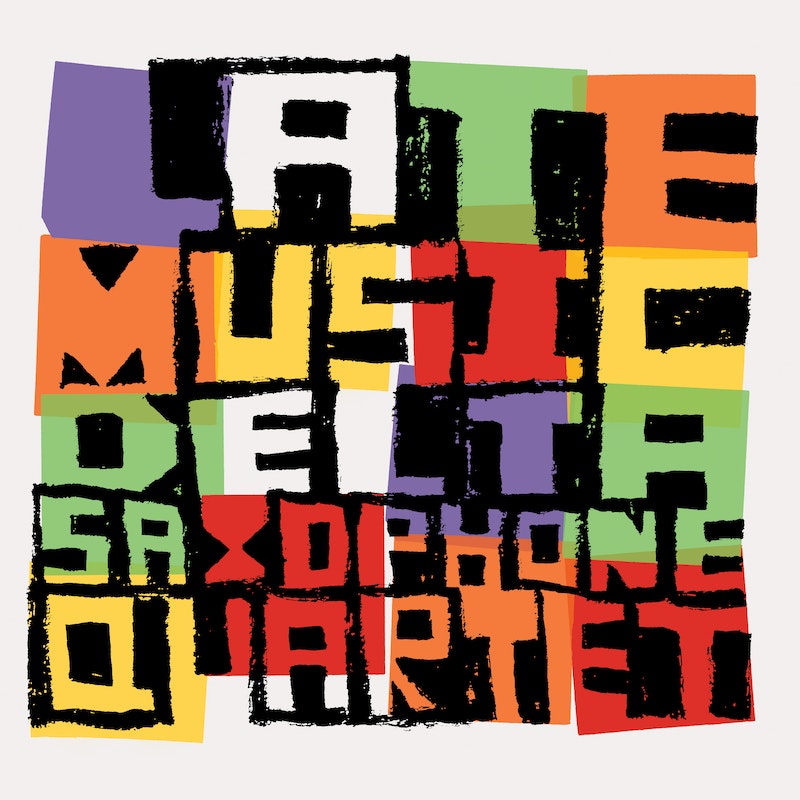
December 2023: the latest release by the Delta Saxophone Quartet – Late Music – contains cut-down versions of my Arabic lute transcription, Damascene Redux, alongside pieces by composers associated with Late Music York as well as music by Joe Duddell, Steve Martland, Hayley Jenkins and others.

December 2023: the latest release by the Delta Saxophone Quartet – Late Music – contains cut-down versions of my Arabic lute transcription, Damascene Redux, alongside pieces by composers associated with Late Music York as well as music by Joe Duddell, Steve Martland, Hayley Jenkins and others.

The digital release of the album includes an EP on which an extended version of Damascene Redux can be heard (the versions on the physical CD are blink-and-a-miss length and function as connective tissue between other pieces).

It was way back in 2014 that the Deltas premiered this piece which is actually a reworking of an earlier brass quartet, Damascene Portrait, so it is very gratifying to hear them revisit it almost a decade later. They have been busy with the piece, performing it in workshops with school children and students up and down the UK. Damascene Redux was always conceived as being open to improvisatory exploration so I am delighted it is being used as a vehicle for music education.

A Book of Song

July and September 2023: in central London working with pianist and fellow composer Nathan Williamson and a trio of singers. Our aim is a modest one – nothing less than to reconfigure the traditional classical vocal recital!

July and September 2023: in central London working with pianist and fellow composer Nathan Williamson and a trio of singers. Our aim is a modest one – nothing less than to reconfigure the traditional classical vocal recital!

With singers Clara Barbier (soprano), Magid El-Bushra (countertenor) and Rob Gildon (baritone) Nathan and myself are attempting to establish a five-way collaboration in which we all work from the ground up to create a seamless programme of song. I am leaving details deliberately vague at this point but we aim to challenge convention through choice of song, use of translation, contrafact, arrangement and improvisation. We need to perform a delicate balancing act in which we maintain enough connection with the tradition of Western classical vocal performance to be able to attract seasoned as well as new audience members.

What has been most gratifying about the two sessions we have held so far is the way in which we have quickly adopted an improvisatory mode of working. As Nathan puts it we are ‘working to tape’ – trying things out, recording and listening back to the results rather than relying on notation with its imperative for the singers to ‘learn’ and practice things. The resulting spontaneity has been refreshing for us all and, more importantly, resulted in an exploratory and risk-embracing working method that has already yielded some surprising and beautiful results. Watch this space!

Roll Over Beethoven

August 2023: down to the country (Hampshire to be exact) to work with Tim Redpath and Rachel Calaminus of Trifarious on our latest project.

August 2023: down to the country (Hampshire to be exact) to work with Tim Redpath and Rachel Calaminus of Trifarious on our latest project. Like so much of the work I’m involved in at the moment this one is running and running, by which I mean it’s taking a long time (!), but this session felt pivotal in moving from one phase to another.

Without wanting to give too much away, together we are exploring that very productive interface between composition and arrangement. Whilst there is very little, if any, original music in the programme we are designing there is, we hope, very original intervention in already existing music. Beethoven enters the picture in the shape of his fifth symphony and its famous first movement; Tim and Rachel have already made a multitrack version of most of the orchestration but the project has become rather overwhelming in scale so what we aimed to do in this session was to plan out a more collaborative approach that shared the considerable burden of completing the music. As always, though, with collaboration we ended up somewhere rather different and are now thinking of the Beethoven as a kind of ‘glue’ between the other elements of the programme. Making such an iconic piece work as a kind of connective between other, mainly much less well known, pieces looks likely to pose a range of challenges however there is a precedent of sorts in Luciano Brio’s use of the scherzo from Mahler’s second symphony in his Sinfonia of 1968. We are working to different aesthetic values from Berio but it is reassuring someone has tried this before us.

Music and/as Process Ten Years On

June-July 2023. It was lovely to return to the Music and/as Process conference a decade after my last visit.

June-July 2023. It was lovely to return to the Music and/as Process conference a decade after my last visit. A lot of water has flowed under the bridge since I presented back in 2013: my own academic career, the research group itself and the state of practice research in academia have all evolved. Ma/aP now appears more diverse and wide-ranging with a marked emphasis on projects situated both inside and outside the academy engaging with music in a swathe of sociocultural settings. Practice research has established a stronger footing in academia, at least in the UK, although it remains depressing how often University senior research managers need to be reminded that there are outputs in research other than those involving the written word churned out in journal articles. I feel more sure of myself as a practitioner-researcher these days, of how I want to present my work and the function of research and writing within my various compositional projects.

The theme of this tenth anniversary conference was ‘making music together’. My paper, Together Apart: Collaboration, Distributed Creativity and Technology in a Transatlantic Musical Partnership, discussed The Gramophone Played – my ongoing project with cellist Madeleine Shapiro – and the ways in which the heavily technologically mediated aspect of our collaboration (we have met in person only once in the eleven years we have been working together) has affected the ways in which we have worked on the music and, indeed, is reflected in the music we have produced. I should actually have used the phrase ‘our paper’ because Madeleine contributed significantly to the content in the shape of audio reflections on our joint work that I was able to integrate and respond to; she also joined delegates and myself for a live Zoom Q&A from New York.

Musical Collaging with Jakob Fichert

March 2023: up in York with pianist Jakob Fichert to explore a collaging project incorporating Dance Maze. Jakob played on the eponymous CD recorded in 2017 that involved two versions of the piece with piano – Dance Maze Variations (the original version dating from the early 90s) and Dance Maze Duos (a 2017 re-working for piano and trumpet). Jakob and I are now working on a ‘composed programme’ that aims to ‘suture in’ a number of other pieces to Dance Maze’s discreet sections.

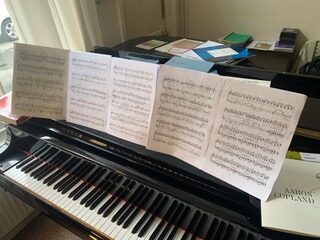
March 2023: up in York with pianist Jakob Fichert to explore a collaging project incorporating Dance Maze. Jakob played on the eponymous CD recorded in 2017 that involved two versions of the piece with piano – Dance Maze Variations (the original version dating from the early 90s) and Dance Maze Duos (a 2017 re-working for piano and trumpet). Jakob and I are now working on a ‘composed programme’ that aims to ‘suture in’ a number of other pieces to Dance Maze‘s discreet sections. I arrived in York with very little in the way of concrete ideas apart from using Copland’s Variations as one of the collage elements and a bunch of possible techniques for segueing from one piece to another. What was heartening was the ease with which Jakob and I quickly assembled a host of pieces to work with and then found felicitous connections between them. Having worked with Jakob on the CD I wasn’t surprised at the ease with which he was able to connect pieces and to negotiate the many routes we worked out through the material. We aim to continue developing our collage over the summer, ‘road-testing’ it with some informal domestic concerts before rolling out a complete version at concerts in York and Surrey universities and, subject to our promotional flair, other festivals and concert series across the UK. My interest in the ‘programme-as-collage’ stems from the recycling and self-borrowing techniques that have been a feature of my music since JPR in 2015. I have become increasingly keen to explore the boundaries between arranging and composing as well as ways in which classical music can be presented in more innovative formats such as the programme without breaks described above.

The pieces Jakob and I collaged with (apart from my own) were: John Adams Phrygian Gales and American Berserk, Bela Bartók Four Dirges, William Byrd The Bells and one of his many fantasies from the Fitzwilliam Virginal Book, Aaron Copland Variations, Steve Crowther Piano Sonata No. 4, Hans Werne Henze Theme and Variations, Franz Liszt Angelus and Sunt Lacrimae Rerum, Max Reger Variations and Fugue on a Theme of Bach.

Bouncing Back in Wymondham

Early in 2023 I received a text from Margery Baker, conductor of the Wymondham Youth and Pulham Village Orchestras, to the effect that Bounce (a piece dating all the way back to 2004) is to be played again in August as part of the orchestras’ 40th anniversary celebrations. News like this is always really uplifting to hear as repeat performances, particularly of orchestral pieces, are rarely easy to come by.

Early in 2023 I received a text from Margery Baker, conductor of the Wymondham Youth and Pulham Orchestras, to the effect that Bounce (a piece dating all the way back to 2004) is to be played again in August as part of the orchestras’ 40th anniversary celebrations. News like this is always uplifting to hear as repeat performances, particularly of orchestral pieces, are rarely easy to come by. Bounce was commissioned by Making Music as part of their Breakout scheme that paired professional composers with amateur ensembles up and down the country. A successful relationship with an amateur performing organisation involves skill and sensitivity on the part of the composer and open-mindedness and a little risk-taking on the part of the performers. I’ve had mixed experiences in this arena (with faults lying in both camps) but the WYO/PO collaboration was one of the best and this was down in no small part to the skill, energy and enthusiasm of Margery Baker, a musical whirlwind dedicated to grassroots orchestral music-making in East Anglia. The title of my piece is a light-hearted nod to Margery’s conducting style that is one of springy, alertness.

I am making a few minor changes to Bounce in advance of the latest performance. I first pulled out the score and listened along with some trepidation – coming face-to-face (or ear-to-ear) with your twenty years younger musical self can be unnerving – but the piece stands up okay and with a snip here and there I’ll be very happy to hear it once more. What the recording also revealed was how well the orchestras coped with the challenges of the score, some of which I would be loath to write again, for example rather fussy variations of immediately repeated material that can act has unhelpful music ‘tripwires’ for amateur musicians. Still, under Margery’s direction I know I’m in very safe hands.

Bartókiana in Budapest

February 2023: Katalin Koltai premiered two pieces from my ongoing Bartókiana project at the Budapest Music Centre. The concert included talks by Katalin, myself and David Gorton with the latter two simultaneously translated into Hungarian. The pieces Katalin premiered were my transcription of Bartók’s Romanian Christmas Carols and Flute of the Slovak Shepherd from For Children.

February 2023: Katalin Koltai premiered two pieces from my ongoing Bartókiana project at the Budapest Music Centre. The concert included talks by Katalin, myself and David Gorton with the latter two simultaneously translated into Hungarian. The pieces Katalin premiered were my transcription of Bartók’s Romanian Christmas Carols and Flute of the Slovak Shepherd from For Children. Bartókiana is composed for the ‘Ligeti Guitar‘, an instrument designed by Katalin that uses magnetic capos in order to independently adjust the pitch of the guitar’s open strings. The capos provide the guitarist and composer with the ability to radically transform the open string ‘background’ of the guitar and can permit all sorts of new chord spacings and textures. This having been said, the capos are tricky to navigate for the non-guitarist particularly when trying to mediate between their affordances and another composer’s music. There are times I have used magnet settings that have proved to be redundant or asked for changes, particularly when Katalin is still playing, that have proved impractical. This partly explains why Bartókiana is proving such a long-running project – the piece was begun in earnest in 2021 and I am still deeply involved in it, currently reworking several of its component pieces. Once completed Bartókiana will consist of ten transcription of various kinds covering Bartók’s folk arrangements from each geographical area he collected in including North Africa and Turkey. Bartók’s musical personality and technique are, of course, formidable and I have had to work hard not to let his style overwhelm my own, hence the number of revisions made so far. Bartókiana is very much a work in progress but I’ll get there.