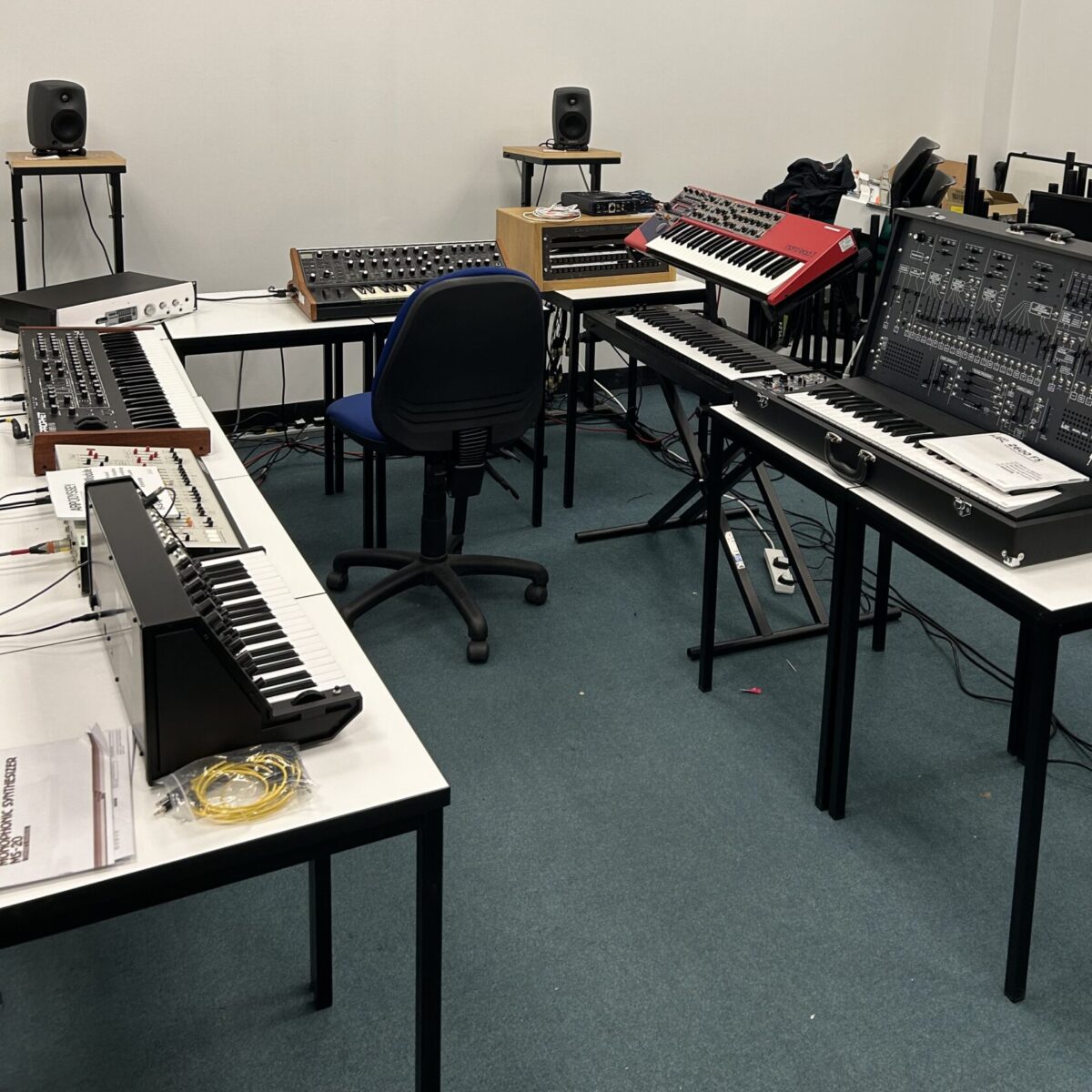
July – September 2026: I’m at work in the Music and Media Synth Lab at the University of Surrey on a new project for synths and surround sound recordings. As I work more with synthesisers I realise the approach that suits me best is a very instinctive one in which I select basic sounds on the basis of what they draw from me in terms of improvisation. I have tried more systematic cataloguing but this just tends to become a rather numbing, uninspiring process and I am always drawn back to improvising and trusting my ear.
The project is in its very early stages and I have little idea of what it is going to sound like or what form it will take aside from a sense that I want it to be fairly substantial – about 45 minutes, i.e. one half of a concert. What is more certain are the collaborators I am working with, or will be once my synth experiments are advanced enough: festival director and early music champion Matteo Gemolo – an artist in residence at Surrey for 26-27 supported by the Institute of Advanced Studies – and Tom Hall – composer, musicologist and long-term Surrey colleague who is an expert on, amongst other things, surround sound production and aesthetics.
I first encountered Matteo at the Royal Musical Association annual conference at Goldsmiths in 2020 where he was talking about his work with extended techniques on the baroque flute as realised by his ensemble at the time, Europa Ritrovata. A couple of years later we began conversations over a possible collaboration, initially involving the performance of my JPR. We applied to the IAS at Surrey with a rather ambitious project that was turned down but as my interests in synths developed I saw a pathway for bringing Matteo to Surrey on his own to work on a new piece together. Since 2020 Matteo’s career has expanded and evolved; he has recently decided to concentrate his energies not on performing/recording but on festival direction – he currently directs the Coudenberg Sound Box Fest in Brussels. Matteo’s career reorientation explains why he will be present in acousmatic form only in our piece.
Matteo’s background in eighteenth century flute performance and his commitment to early music provides one more firm aspect of this otherwise very open project – the music recorded by Matteo will be from eighteenth century (and earlier) treatises on playing the flute. We are hoping that these historical documents will furnish us with spoken word materials as well as music, perhaps touching on aesthetic ideas and debates of their time and very likely transformed through technologies of our time using various forms of processing. I imagine music from these treatises (which can contain entire pieces, not simply examples) being superimposed on each other as they constantly move around the space. The synthesiser parts (played live by me) will very likely be improvised, accompanying (although that is probably too neutral a word) the recordings. I am hoping that the process of selecting the recordings to use and how to combine them will involve all three members of the project team; one aspect of my compositional practice that has developed markedly over the years is my ability to harness the potential of collaboration – I think this is going to be needed if the most is to be made of the rich musical resources at our disposal.
